Moon Phase Today
Check the current moon phase and lunar phase tonight: new moon, crescent, full moon or waning. See the illumination percentage, distance to Earth, zodiac constellation and countdown to the next phase.
Moon Phase Today
Calculating today's moon phase…
Lunar Calendar
Check the moon phase on any other date of the month.
- ✓Current Moon Phase
- ✓Lunar Calendar
- ✓Sky Finder
- ✓Sky Trail and Trajectory
- ✓Eclipses
- ✓Astronomical Data
About this tool
The tool automatically calculates today's moon phase using high-precision astronomical ephemeris models and provides a complete monthly lunar calendar to check any date.
Understand the Moon Phases
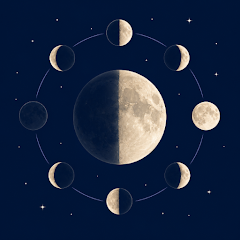
The lunar cycle (synodic month) lasts about 29.5 days and is divided into 8 distinct phases, reflecting the portion of the Moon illuminated by the Sun from Earth's perspective. Learn about each phase:
New Moon
The Moon is positioned between the Earth and the Sun. Its illuminated side faces the Sun, making it completely invisible to us in the night sky.
Waxing Crescent
A sliver of light begins to appear on the edge. This marks the start of the Moon's journey from darkness toward full illumination.
First Quarter
Exactly half of the moon's disk is illuminated. The Moon has completed one-quarter of its orbit around the Earth since the New Moon.
Waxing Gibbous
More than half of the Moon's surface is illuminated, growing larger each day but not yet reaching the complete circle of the Full Moon.
Full Moon
The entire visible face of the Moon is 100% illuminated by the Sun, shining at its peak brightness in the night sky all night long.
Waning Gibbous
After the full phase, the illuminated surface begins to shrink progressively, though more than half of the Moon remains visible.
Last Quarter
The opposite half of the Moon's disk (compared to the First Quarter) is illuminated, marking the final quarter of the lunar orbit cycle.
Waning Crescent
Only a thin silver curved sliver of light remains visible. It is the final phase of the cycle before it resets back to a New Moon.
Visually, the cycle looks like this:
What is Moon Illumination?
Illumination represents the percentage of the Moon's Earth-facing side reflecting sunlight towards Earth. It ranges from 0% (New Moon) to 100% (Full Moon) as the relative positions of Earth, Moon, and Sun change.
What is Moon Age?
Moon age is the number of days since the last New Moon. Because the complete lunar cycle averages 29.53 days (synodic month), the age ranges from 0 to 29.5 days, telling us exactly where the Moon is in its cycle.
Why Does the Distance to Earth Change?
The Moon's orbit around Earth is elliptical rather than circular. Its distance fluctuates continuously between approximately 356,500 km at perigee (closest point / Supermoon) and 406,700 km at apogee (farthest point / Micromoon), with an average distance of 384,400 km.
How Does the Moon Transit the Zodiac Constellations?
As the Moon orbits Earth, it completes a journey through all 12 zodiac constellations roughly every 27.3 days (sidereal month). It spends about 2 to 2.5 days passing through each constellation, which is tracked for astronomical observation and astrological traditions.
Traditional Full Moon Names
Every full moon of the year has a popular name from North American tradition, usually tied to the seasons and nature. See the name for each month:
January
Wolf Moon
Named for the howling of wolves heard through the cold winter nights.
February
Snow Moon
Reflects the heavy snowfall typical of this month in the Northern Hemisphere.
March
Worm Moon
Marks the time when earthworms reappear as the ground begins to thaw.
April
Pink Moon
Named after wild ground phlox, one of the first spring flowers to bloom.
May
Flower Moon
Celebrates the abundance of flowers blooming across the Northern Hemisphere.
June
Strawberry Moon
Coincides with the strawberry harvesting season in North America.
July
Buck Moon
Named for the new antlers that emerge on deer bucks around this time.
August
Sturgeon Moon
Refers to the sturgeon fish, most easily caught in the Great Lakes during this month.
September
Harvest Moon
The full moon closest to the autumn equinox, traditionally lighting the way for late crop harvests.
October
Hunter's Moon
Marked the start of hunting season as animals fattened up for winter.
November
Beaver Moon
Named for when beavers build their winter dams before the swamps freeze.
December
Cold Moon
Marks the arrival of long, cold winter nights.
Features
Use Cases
- Planning rural activities such as planting and harvesting according to the lunar calendar.
- Checking the moon phase for nighttime photography and amateur astronomy.
- Rituals, spiritual practices, and meditations guided by the lunar cycle.
- General curiosity about the moon's cycle and basic astronomical education.
How to use
See the Current Phase
When you open the page, today's moon phase is displayed automatically with name, illustration, illumination percentage, and distance.
Choose Your Hemisphere
If you are in the Southern Hemisphere, select 'Southern' to see the moon illustration in the correct orientation.
Check the Next Phase
See how much time remains and the exact date/hour for the next principal phase: first quarter, full moon, last quarter, or new moon.
Explore Distance, Zodiac & Orbital Status
Check detailed astronomical metrics including current distance in km, active constellation, and supermoon/micromoon proximity indicators.
Questions & Answers
Calculations are powered by high-precision astronomical algorithms (VSOP87/ELP2000 planetary and lunar ephemeris). They account for the Moon's real elliptical orbit and solar perturbations to deliver minute-accurate phase timings.
The moon appears mirrored depending on the hemisphere. In Australia and other southern countries, the crescent appears on the opposite side compared to the Northern Hemisphere. That is why we offer a hemisphere toggle.
Yes. Illumination is computed in real time from the exact geocentric vector and sun-moon phase angle, giving precise percentage values.
A supermoon happens when a full moon coincides with perigee, the point in the Moon's orbit closest to Earth. It can appear up to 14% larger and 30% brighter than a full moon at apogee, its farthest point.
A blue moon is the second full moon in a single calendar month, or the third of four full moons in one season — it has nothing to do with color. Because the lunar cycle is about 29.5 days, this happens roughly once every two to three years, giving rise to the expression "once in a blue moon."